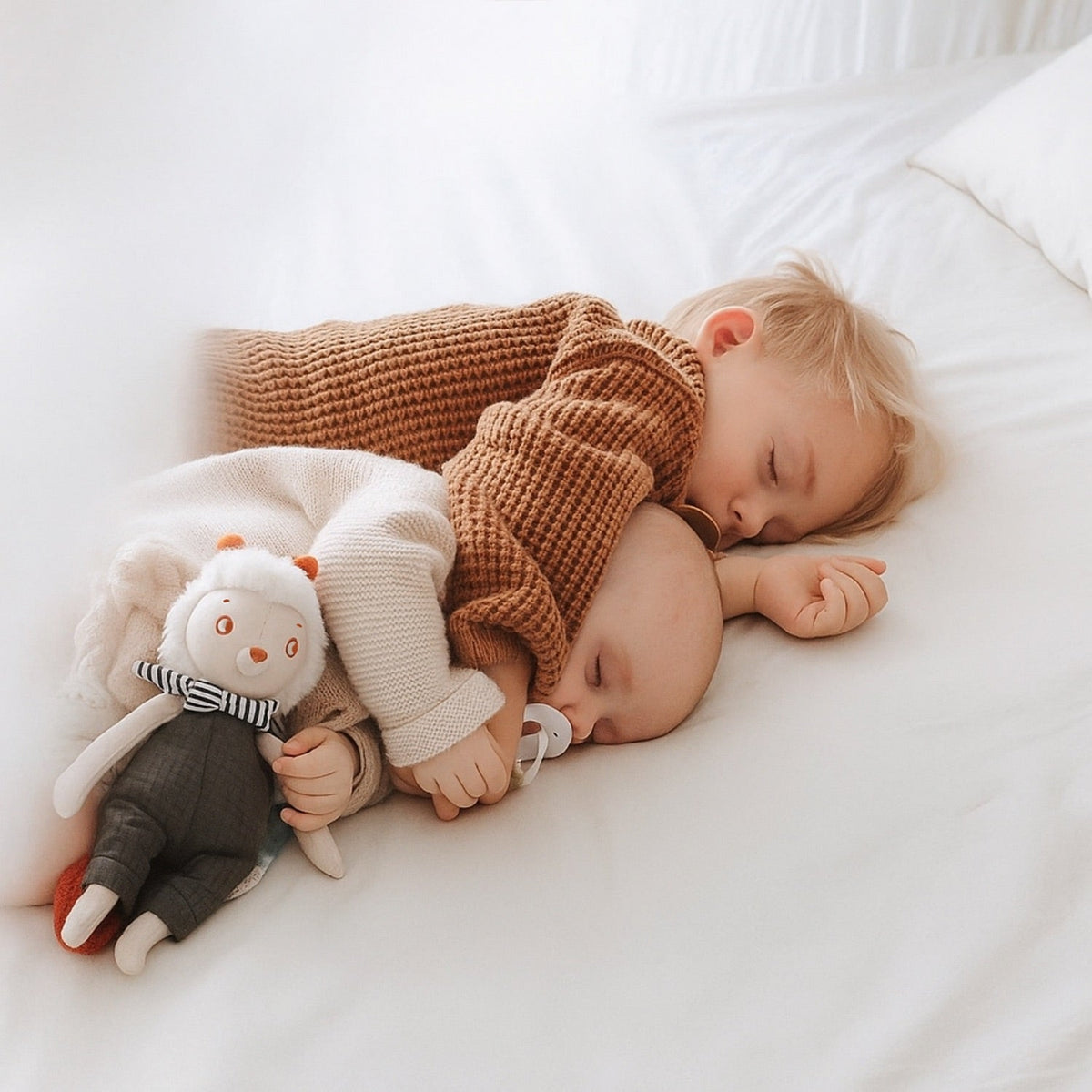


There's a detail that confuses even those who love to give gifts: a baptism isn't a birthday. It's not just "something for the baby," but a gesture that lives on in photos, in family stories, and sometimes, in a drawer that's reopened years later. That's why the real question isn't just what to give at a baptism, but what kind of memory you want to leave behind—practical, symbolic, or both.
The most useful starting point is the baby's age and the time the gift will be used. Many baptisms occur in the first few months, when parents are already in the midst of their routines (feeding, sleeping, changing). In that case, a well-chosen gift is one that fits into daily life without creating clutter or duplication. If the baby is already a few months older, however, it makes sense to focus on play and discovery: objects that accompany the first intentional gestures, curiosity, and motor skills.
What to give for a baptism: starting from the "when"
The most “boutique” criterion – therefore concrete, but with taste – is to think about three windows of use.
If you want to be useful right away, choose something parents will use in the next 30 days: a soft textile, a bedtime accessory, a small item for the evening routine. If you want to give something that won't be "burned out" in a week, aim for 3-12 months: soft toys, first sensory toys, tactile books, or a lamp/nightlight designed to last. If you want to give a gift that "grows," think about 12-24 months: first puzzles, wooden toys, dolls and characters to invent, or even the first carefully chosen shoes.
There's no one-size-fits-all choice: it depends on how well you know the family and how much you want to be present in their daily lives. A keepsake is beautiful, but if it's also usable—and therefore lived in—it's often doubly valuable.
Textile Gifts: Soft, Photographable, Really Used
Blankets, throws, muslins, bathrobes, and bath towels are seemingly simple gifts, but they make a difference when chosen well. Their value lies in the materials and finishes: skin-friendly fibers, meticulous stitching, and enduring colors that fit seamlessly into a nursery without becoming an out-of-place item.
A hooded bathrobe, for example, becomes a part of the routine from day one and remains useful for years. A stroller or crib blanket accompanies naps and walks, and is one of those items that end up in a thousand photos without ever becoming an intrusive protagonist.
The trade-off here is clear: textiles are very useful, but less "iconic" than a symbolic gift. If you want to take things to the next level, you can choose a blanket or bath set with a more sophisticated aesthetic, or pair it with a small, matching soft toy.
Soft toys and puppets: safety and imagination
A baptism is the perfect occasion to give a loved one a gift: a stuffed animal, a soft doll, or a comforter. It's a classic gift that combines tenderness and functionality, as it often becomes a source of comfort. The key is choosing the right size (not oversized), reliable materials, safe details (no easily detachable parts), and a design that stays beautiful even after numerous washes.
Here, brands truly act as a “risk reducer”: if you choose a well-made character designed for small children, the gift is not only cute, it is also reassuring for parents.
If you want something particularly fitting for the context, narrative collections work very well: characters that seem to have stepped out of a picture book, with a distinct personality. Among the names that are popular precisely because they have a delicate and recognizable imagery are Moulin Roty and Maileg: puppets and mini-characters that never go out of style and are sure to become a favorite.
Sensory games (0-12 months): small, intelligent, never random
When a baby is very young, play is all about hands discovering, eyes following, and gentle sounds. This is why sensory toys are often a perfect gift for a baptism: they don't take up much space, and they're meant to be used, not just looked at.
A well-balanced rattle, a grasping ring, a toy with different materials to touch, a soft sensory book: these objects seem simple, but they must be well-designed. The difference is felt in the details: weight, texture, soft colors, easy-to-grasp parts, easy to clean.
The limit? These gifts don't always make a splash when opened. If you're looking for a wow factor, choose a quality, sensory piece with a refined aesthetic, or a coordinated set (but don't overdo it: two good pieces are better than five fillers).
Wood and first “board” games (12-24 months): when the gift becomes an activity
If the baptism arrives when the child is approaching his first birthday or has already passed, you can give something that becomes a ritual: a simple puzzle, a puzzle game, a small wooden construction set, a role-playing game. This is where brands like Djeco , Janod, and Londji come in, which have a specific style: clean design, age-appropriate materials, and a play concept that never gets old.
These gifts have one advantage: they can be shared. They're not just "the child's," but create a moment between adult and child. And in a new family, those ten minutes of play together are almost worth more than the gift itself.
But be careful about two things: the recommended age and the space available in your home. A beautiful but overly complex toy risks being left on the shelf. And a large object, if not requested, can become a logistical problem.
Bedtime Items: The Gift That Makes Your Night Better
Bedtime is one area where a gift can be truly lifesaving, but only if it remains essential. A gentle nightlight, a small, child-themed bedside lamp, or an element that makes the routine more peaceful (such as a soft toy "bed" or a well-made music box) are ideas that parents appreciate because they're easy to manage.
Style matters a lot here: a lamp should complement the bedroom, not dominate it. Soft lines and warm colors are the easiest choice for gifts, as they rarely clash.
The trade-off is that these objects are more “homely” than “the child’s”: they are beautiful gifts, but less personal if you don’t accompany them with a thoughtful card and a dedication explaining the reason for the choice.
First shoes and accessories: beautiful, but only if you know your size
Giving shoes as a gift at a baptism is a very special gesture: it's like saying "I'll accompany you on your first steps." However, it's also one of the most delicate choices, because size and shape really matter, and every child takes their first steps differently.
If you're looking for this type of gift, the smartest solution is to do so when you're sure of the size or when you can coordinate with the parents. In that case, brands like Bobux, Biomecanics, and Camper (kids' lines) are often chosen by those seeking quality, premium materials, and a design that doesn't look like a "miniature adult."
If you're unsure of the size, it's best to opt for more flexible accessories: a well-made hat, a small backpack for kindergarten (when the time comes), or an accessory for going out. Affenzahn, for example, is beloved precisely because it combines functionality and personality.
Souvenir gifts that don't end up in a drawer
Many people look for a symbolic object for a baptism, but the risk is giving a gift that only lasts on the day of the ceremony. If you want a lasting memory, choose an object that can be used and treasured.
A memory box to hold little treasures, an album for photos of the first few months, a tastefully designed nursery decoration, or a doll or character that becomes part of childhood: these are choices that make sense because they grow with the child's story.
Here, it depends a lot on the family's style. If you're unsure of their tastes, stick to neutral colors and clean lines, avoiding overly expressive or written objects. The best keepsake is one that doesn't force anyone to move house to make room for it.
How to choose well without asking "what do you need?"
Sometimes you don't want to bother parents with practical questions, but you want to avoid duplication. A simple method is to choose a "multi-purpose" gift: something that will be used multiple times and is difficult to over-promise, like a quality bathrobe, a blanket, a well-made stuffed animal, or a nightlight.
If you want to be very specific, you can ask just one thing: the child's age and the style of the nursery (two pieces of information that change everything). A ten-second chat is all it takes to avoid the classic mistake of giving a toy that's too old or an item that will never be used.
If you're looking for a selection already organized by age, use, and brand—so you don't waste time searching for thousands of similar options—on PIPI & PUPU and friends you'll find clear choices for sleeping, bathing, playing, and accessories, featuring recognizable European brands and meticulous attention to materials and design.
Budget: The “right” gift isn't always the most expensive one.
Baptisms can have very different budgets: sometimes a small but carefully chosen gift is given, other times a more substantial one (especially from godparents). It's helpful to think in terms of "use value" and not price.
A quality stuffed animal that will be a companion for years can be worth more than an expensive but impractical item. And a simple but cohesive set (for example, textiles + a small toy) often conveys more care than a large gift chosen in a hurry.
If you want to give a meaningful gift without taking risks, choose something that will last and that doesn't depend on specific sizes or preferences: well-designed wooden toys, an elegant bedroom light, an iconic piece from a collection that can be passed down.
Ultimately, those who receive a baptism gift don't just remember the object. They remember how they felt: seen, respected, cared for. If you choose a thoughtful, well-crafted gift that's appropriate for that child's real life, you're already doing the rarest thing: giving the parents a sense of lightness and the little one a sense of wonder.
0 comments