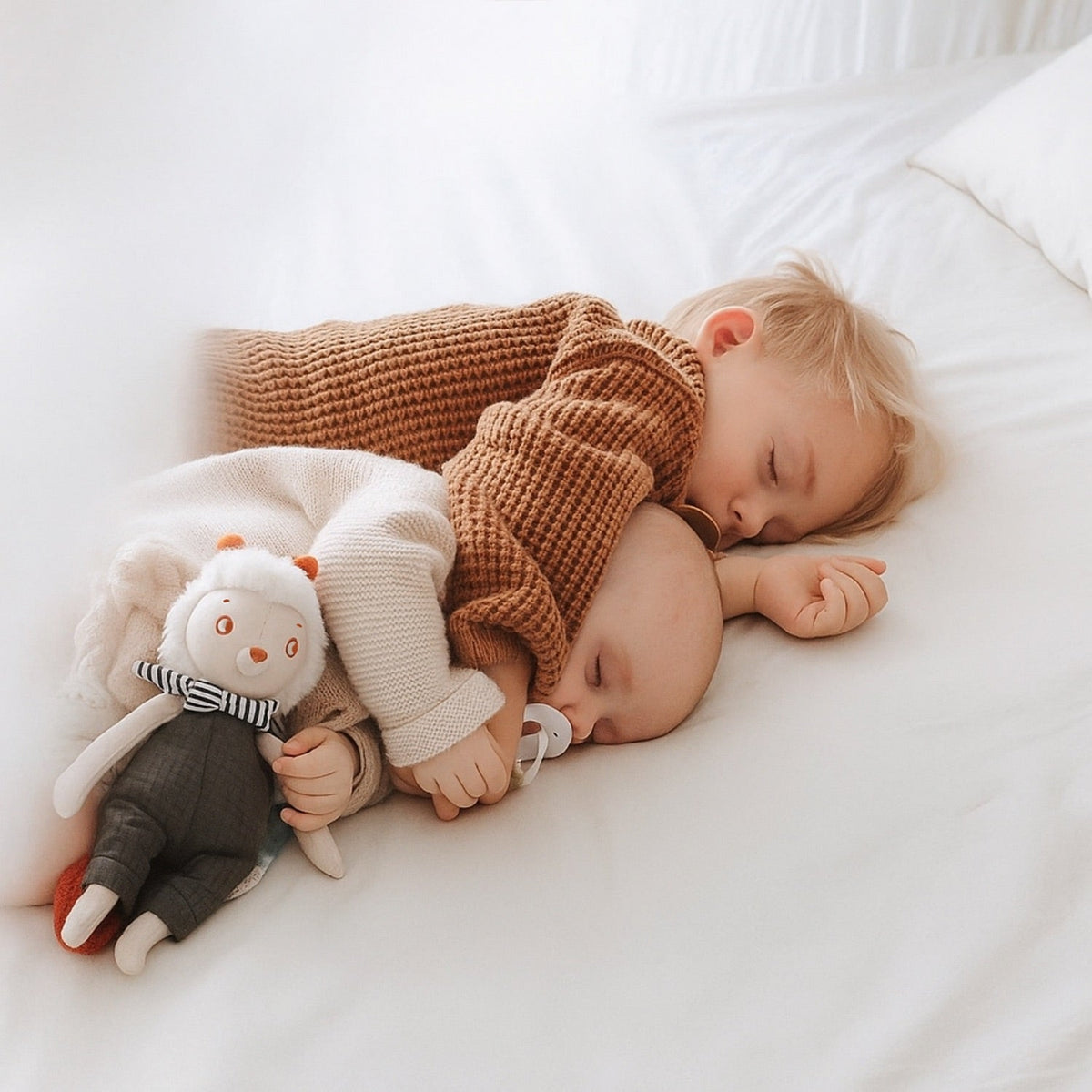


A stuffed animal that "looks" natural but smells like new plastic. A beautiful puzzle, but with unsatisfactory paint. Or the classic toy that already has a broken piece after two weeks. If you're looking for sustainable toys for children, you're probably not just interested in the "eco" label: you want credible materials, meticulous finishes, real safety, and items that stay in the home without quickly becoming waste.
This is a practical guide, designed for those who are buying for a newborn, a toddler, or a preschooler, and want to choose well the first time—without turning every purchase into a survey.
What does “sustainable toy” really mean?
"Sustainable" isn't a single category. In the gaming world, four dimensions are typically intertwined: materials, chemical safety, durability, and supply chain.
Materials are the most visible part: wood, cotton, natural rubber, paper, and cardboard can reduce reliance on virgin plastics. But the point isn't to demonize plastic altogether. A high-quality, well-designed, and repairable plastic toy can last for years and be passed down from generation to generation. On the other hand, a "wooden" object with poor-quality glue and finishes that splinters quickly isn't sustainable for anyone.
Sustainability, for those buying for children, includes safety: paints, inks, treatments, and adhesives are as important as the base material. This is where European standards and quality controls come into play. You don't need to be an expert in regulations, but it's helpful to demand transparency and reliable brands.
Durability and repairability are often the real dividers. A toy that stands up to drops, saliva, washing, and the typical "tests of character" that occur over a 2-4 year period prevents repurchases and waste. Finally, there's the supply chain: European or non-EU production, brand policies, packaging, and logistics. You can't always have it all, but you can make informed choices by knowing where you're compromising.
Materials: What to Look for and What to Carefully Evaluate
Wood is a classic for toys for ages 1-5: puzzles, trains, play kitchens, and baby carts. It's pleasant to the touch, stable, and generally holds up well to small impacts. The right question here isn't just "is it wood?", but "how is it finished?" Opt for smooth surfaces, without sharp edges, and paints suitable for children (children put everything in their mouths, even when they shouldn't). If the toy is colored, check that the paint doesn't peel easily—it's a simple but useful clue.
Textiles (cotton, linen, velvet, wool) dominate in early childhood: comforters, soft dolls, stuffed animals, and accessories for pretend play. It's a perfect fit for sustainability, but even here there are variables: padding, dyes, and stitching strength. A "soft" stuffed animal that loses shape or sheds fluff after a few washes isn't a great choice, especially for babies aged 0-2 years.
Paper and cardboard are often underrated. Puzzles, memory games, theaters, and lightweight constructions can be excellent alternatives when the print quality and thickness are good. The trade-off is resistance to liquids and chewing, which is why they often work best for ages 3 and up, or as guided activities.
Natural rubber and food-grade silicone are typical materials for teething and bathing. Here, sustainability intertwines with hygiene: objects that are easy to wash and free of cavities that retain water are preferable. Even a "natural" product can become problematic if, in practice, it accumulates moisture and doesn't dry properly.

Security: It's not an extra, it's the basic requirement
When it comes to children, sustainability without safety is just marketing. Safety is about details: size (no small parts for 0-3 year olds), tensile strength (eyes and buttons), absence of sharp edges, colorfastness, and materials suitable for oral contact.
If you're buying a gift and aren't sure how old your child is, a simple rule applies: a "larger and simpler" object is better than a complex set with tiny components. A well-crafted stuffed animal, a wooden activity cube, a soft doll, or a large puzzle are safer and longer-lasting choices.
There's also a less obvious issue: sensory load. Many modern games rely on lights, sounds, and constant stimulation. It's not a question of "right or wrong," but of use. If you're looking for a sustainable game in the broadest sense, simplicity often benefits: an object that leaves room for imagination is used longer and in more diverse ways.
Choosing by age and stage: sustainability is also "timing"
Buying "with a view to the future" may seem smart, but it isn't always. A game that's too advanced stays in the closet and loses its appeal. A game that's too easy gets boring in a few days. The sustainable choice is often one that focuses on the child's here-and-now.
0-12 months: comfort, touch, rituals
At this stage, toys are contact objects: comforters , rattles , small soft books , teethers , activity mats. Washability, secure stitching, and softness are important. A well-made comforter becomes a "treat of the heart" and lasts for years, often longer than any electronic toy.
1-3 years: movement and first autonomy
Developmental toys are key here: stacking toys, large puzzles, carts, basic play kitchens, simple musical instruments, and pull-along toys. Sustainability lies in sturdiness and stability. A good wooden or textile toy, at this age, is put to the test every day.
3-7+ years: stories, rules, creation
More complex puzzles, memory games, puppet theaters, creative sets, building blocks, dolls, and accessories for symbolic play take center stage. This is also the age when design matters most: if a toy is nice to leave in the bedroom, it won't end up at the bottom of a box. And when an object remains visible, it's more likely to be used.

Duration: The Question That Changes Everything
Before you add it to your cart, try asking yourself a concrete question: "Will this game last 6 months of real-world use?" Not "ideal use," but the kind that involves drops, transport, snacks nearby, sticky hands, and quick cleanups.
A sustainable toy is often one that:
- it can be cleaned without anxiety (or washed without deforming)
- It has no exposed fragile parts where it is not needed.
- It has a design that doesn't get boring right away
- it can change hands: brothers, cousins, friends
This is why brands with a strong product culture, thoughtful materials, and a tradition of educational play tend to be “greener” choices even when they don’t scream “sustainable” on every package.
Sustainable Gifting: How to Avoid the "Duplicate" Effect
Anyone buying a gift has an additional problem: they don't know what's already in the house. The solution isn't to choose something generic, but something compatible.
A quality stuffed animal or doll is never a duplicate, because it enters the symbolic game in a personal way. A picture puzzle or memory game, if chosen at an appropriate level, integrates well even if the family has other games. And a "contextual" accessory—like a small nightlight, a toy basket, a purse or backpack for outings—is often very useful and less likely to overlap.
If you want to further reduce the risk, focus on items that are suitable for all ages: from 2-3 years onwards, a basic creative set (drawing, collage, stamps) tends to be consumable and therefore truly “runs out”, without becoming cumbersome.
The tradeoff worth knowing: price vs. value
Sustainable children's toys often cost more. Not always, but often, because better materials, quality control, and thoughtful design come at a price.
The key is to distinguish cost from value. If a €35 game is used for two years and then passed on to a younger sibling, it costs less than three €15 games that break or quickly become boring. This logic is especially true for quality wood, well-built dolls, and thick puzzles.
That said, there's no need to "convert" the entire room at once. A sensible strategy is to choose a few anchor toys, ones that can truly withstand daily use, and then supplement them with lighter or more consumable activities.
How to navigate brands and categories without wasting time
When an e-commerce site is organized by age, type, and brand, the choice becomes much simpler: first define the age, then the type of toy (puzzles, dolls, building blocks, bath toys, early childhood), then narrow it down to brands with a clear identity.
If you like a boutique selection, with recognizable European brands and a selection based on materials and finishes, you can use PIPI & PUPU and friends as a shortcut: not as an "endless market," but as a curated shelf where it's less likely to stumble upon random products.
The rule of thumb remains the same: start with use. Bath time, bedtime, outings, free play, table activities. A sustainable toy works when it fits into the routine of the home, not when it's just "cute."
A final thought, to keep near the cart
If you're hesitating between two toys, choose the one you imagine will still be in use a year from now: the one that can be loved, washed, lent, and found again without losing its charm. That's where sustainability stops being a buzzword and becomes everyday life.
0 comments