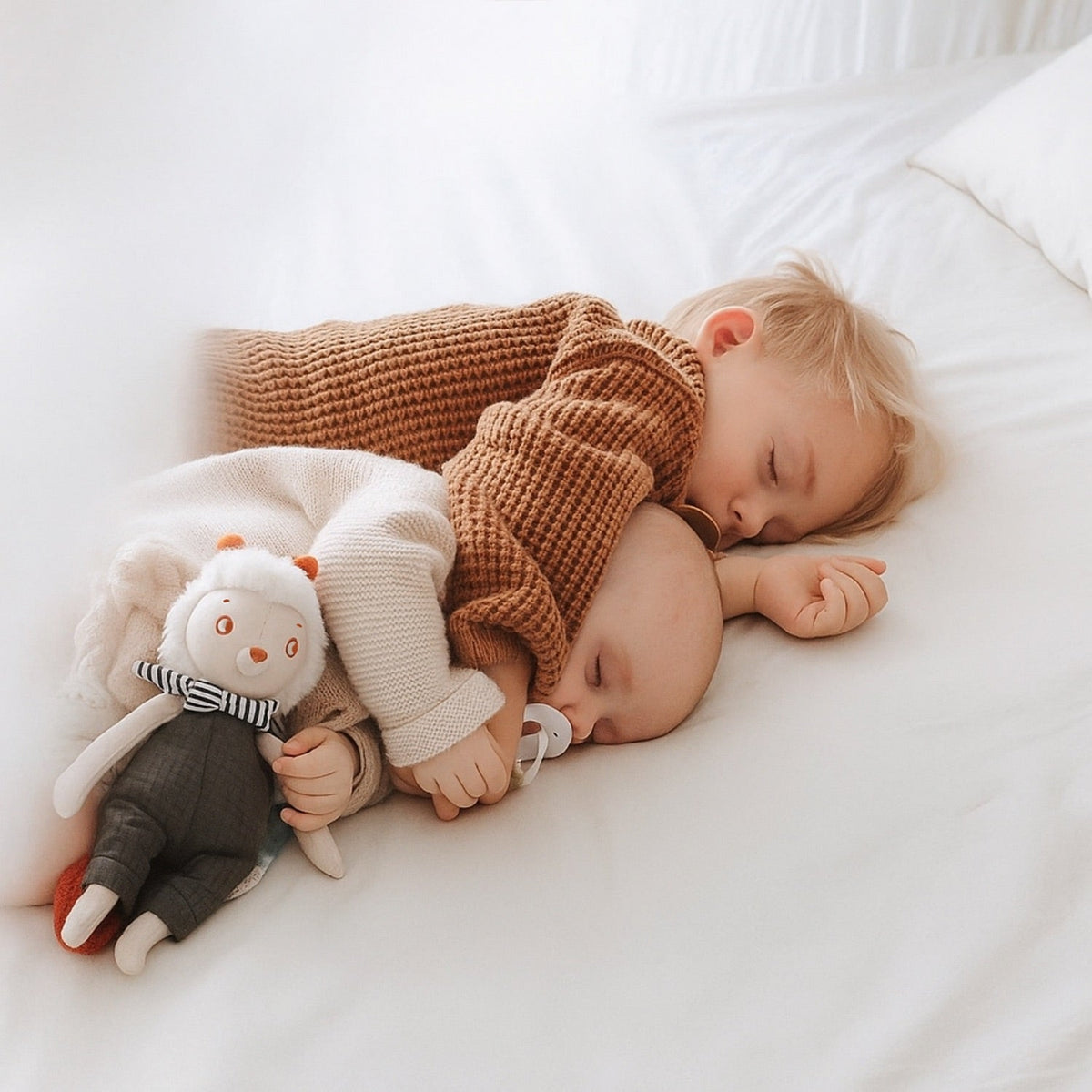


The difference between a quiet night and one full of calls often isn't a big change. It's about having the right light, turned on at the right time, in the right spot in the bedroom.
A children's night light isn't just for "making a little light." It aids in falling asleep, simplifies nighttime awakenings, helps during feedings and changes, and can also become a reassuring small reference when the darkness starts to feel intimidating. This is precisely why it's worth choosing carefully, without just picking the cutest shape or the favorite color.
How to choose a children's night light
When looking at a lamp for the children's room, the temptation is to start with aesthetics. This is natural, especially if you're creating a cohesive, soft, and well-curated space. But the first question to ask is another: when will it actually be used?
For a newborn, the night light mainly serves the adults. It should allow them to see enough during the night without interrupting the baby's sleep too much. In this case, it's very important that the brightness is delicate, not dazzling, and that the light remains warm. A light that is too strong can turn a simple action, like a diaper change, into a complete awakening.
With a slightly older child, however, the emotional dimension also comes into play. The lamp can become a familiar object, part of the bedtime routine, useful for transitioning to a big bed or facing the first fears of darkness. Here, design matters more, but always in conjunction with functionality.
This is why a good choice comes from the balance between four aspects: light quality, material safety, practical use, and visual presence in the room.
Warm light, not cold
The type of light greatly changes the overall effect. For a children's room, cold light is almost always the least suitable choice. It appears harsher, less welcoming, and inconsistent with bedtime.
A warm tone, on the other hand, immediately creates a softer atmosphere. This doesn't mean having to illuminate very little at all costs. Rather, it means avoiding an aggressive, white, or intense light that stimulates instead of aiding rest.
If the lamp offers multiple intensity levels, even better. This is a truly useful feature because the same light can serve different purposes: very dim for falling asleep, a bit more present for a quick check at night, and more intense only when necessary.
Safe materials and reliable finishes
In a children's room, safety is not a technical detail to check at the end. It is the starting point. A children's night light must be designed to be near curious hands, cribs, textiles, and everyday objects.
It is better to opt for solid materials that are pleasant to the touch and clearly designed for children. Soft silicone, quality plastics free of fragile finishes, well-assembled components, easy-to-clean surfaces: these are all elements that make a difference over time.
Stability also matters. A well-designed base reduces the risk of the lamp falling if bumped. If it's a portable model, it's worth checking that it's lightweight but not too delicate, and that it doesn't have small or easily removable parts.
Where to place the night light in the children's room
A well-chosen lamp can function poorly if placed in the wrong spot. We often tend to place it next to the bed or on the nightstand without much thought, but the placement significantly changes the user experience.
For newborns, it's often more convenient to keep it near the changing area or in a spot that discreetly illuminates the path between the crib and the door. The goal is not to make the room fully visible, but to create a guiding light.
For older children, however, a position closer to the bed might make sense, as long as it doesn't point directly at their face. If the lamp is also intended as a reassuring object, it should be perceptible without becoming intrusive.
When the children's room is small, a compact night light helps prevent the space from feeling visually cluttered. In more furnished rooms, with low bookshelves, rugs, poufs, and reading nooks, a clean-designed lamp integrates better and maintains that sense of order that makes the environment more serene.
Plug-in, battery, or rechargeable?
There is no one-size-fits-all solution here. It depends heavily on household habits.
Plug-in models are practical if you want a light that's always ready, without worrying about recharging. They work well in hallways, near the door, or in a fixed area of the bedroom. On the other hand, they limit placement and may be less suitable if you want to move the light.
Battery-powered or rechargeable lamps are very popular because they are more flexible. They can be used on the nightstand, taken on trips, kept near the bed during a transition phase, or moved wherever needed. However, they require a bit more management. If the battery doesn't last long or recharging is inconvenient, the beautiful object risks becoming impractical in the real routine.
For many families, the best choice is a rechargeable lamp that is easy to use and has good battery life. Especially if the child likes to carry it with them for a few minutes before sleeping or use it as a small accompanying light.
Children's night light and bedtime routine
One of the most interesting aspects of these objects is that they are not just functional. They easily become part of daily rituals.
Always turning on the same light, lowering the general tone of the room, reading a story, and then leaving a gentle luminous presence helps create a recognizable sequence. Young children respond well to these repeated signals. It's not magic, nor an automatic solution to all sleep difficulties. But it is concrete support, especially when the routine is consistent.
It can also be useful during times of change. Starting daycare, more frequent awakenings, the transition from crib to bed, or a phase of increased evening sensitivity can make a familiar and stable light invaluable.
Naturally, not all children react the same way. For some, the lamp is reassuring, for others it's indifferent, and in some cases, continuous light can even be distracting. If the child tends to stare at the lamp or remain more alert, it's better to choose a very low intensity or consider limited use during the falling asleep moments.
When design truly makes sense
In a universe full of loud, excessive, or non-durable children's products, a well-designed lamp has value beyond aesthetics. It means choosing an object that remains pleasing over time, that doesn't get tiresome after a few weeks, and that naturally fits into a carefully curated children's room.
Soft shapes, non-aggressive colors, simple lines, and visual quality consistent with the rest of the environment make a difference. This is even more true if the lamp is also a gift idea. Those buying for a birth or a birthday often look for something useful, but also beautiful to look at and keep.
For this reason, in a curated selection like that of a boutique store, the point isn't to have a hundred options. It's about finding well-chosen models, with a childlike yet not trivial aesthetic, reliable materials, and real-life usability. On pipipupu.com, this approach makes sense especially for those who want to buy less, but better.
What to check before buying
Before choosing, it is worth dwelling on some practical details that are often only discovered later. The first is ease of turning on. If you have to search for a tiny button in the dark, convenience immediately disappears. An intuitive control, or even a simple touch if well designed, makes everything more immediate.
Then there's cleaning. Children's lamps often end up in environments where dust, fingerprints, and minor accidents are commonplace. A washable surface without too many grooves is better suited for daily use.
Finally, it makes sense to ask how long you expect to use it over time. For the first few months, a very simple light, designed for adults, may suffice. However, if you are looking for an object that will accompany the child longer, it is worth investing in a more versatile model, with a pleasant presence even after the phase of nocturnal awakenings has passed.
A good children's night light doesn't have to do everything. It should do well what your routine, your space, and your way of experiencing the evening really need. When the choice is right, it is barely noticed - and that is precisely its merit.
0 comments