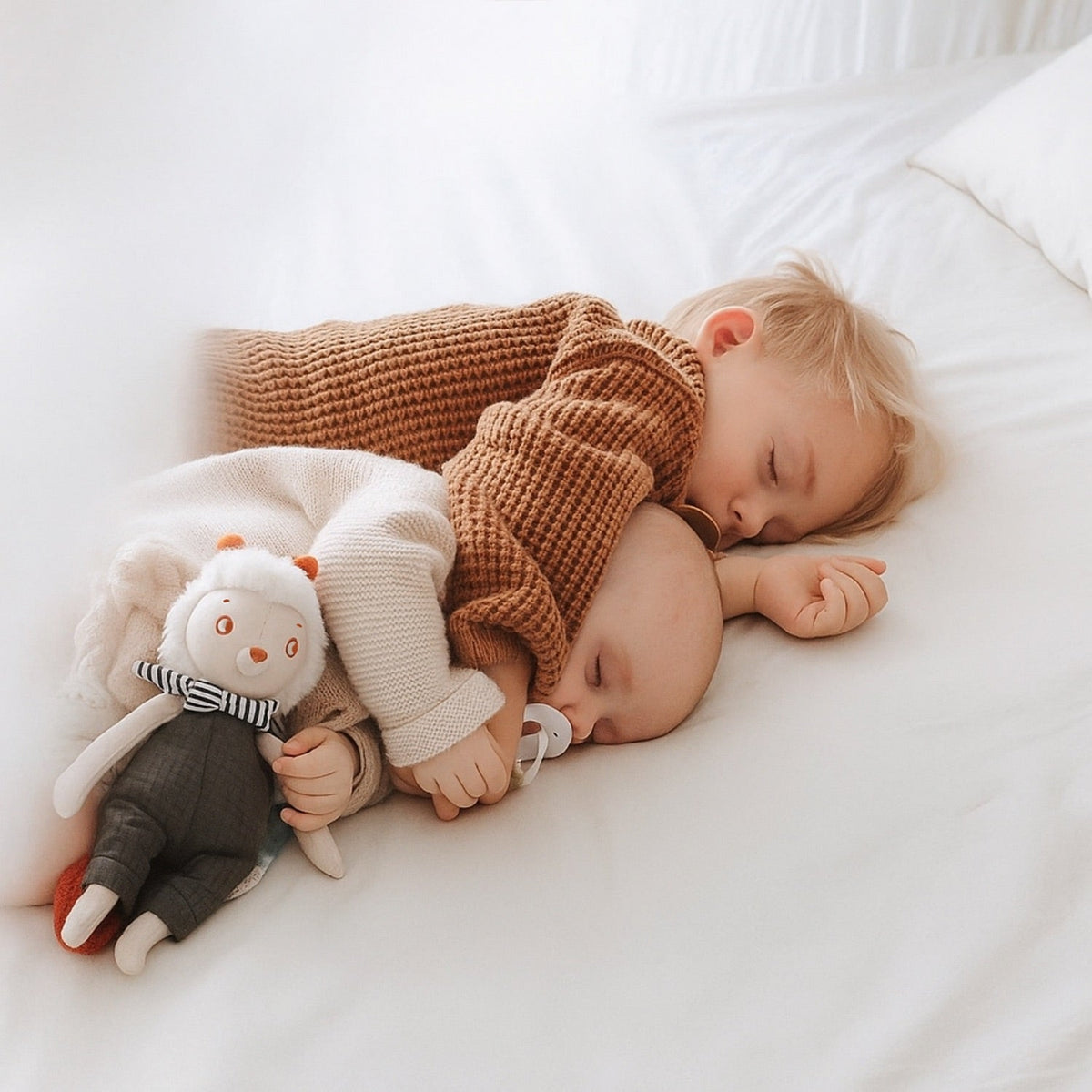


The scene is familiar: a ready-made nursery, a freshly unwrapped gift, and that soft stuffed animal that seems made to be held in a newborn's arms. It's also the moment when many parents ask themselves the right question: "Is it really safe?" In the first few months of life, the difference between a beautiful stuffed animal and a suitable one lies in the details—the ones you don't see in photos, but that matter when baby holds it, sucks it, drags it into the crib, or rubs it against their face.
What “baby-safe plush toys” really means
When we talk about baby-safe stuffed animals , we're not just referring to a "0+" label. It means an item designed for the real-life use a newborn will make of it: prolonged skin and mouth contact, uncoordinated handling, frequent washing, and close contact during calm moments.
Safety here isn't an abstract concept. It's the sum of practical choices: clean and traceable materials, minimal components, sturdy finishes, and sensible dimensions. A stuffed animal for a three-year-old might have interesting decorative elements; for a newborn, those same details often become a weak point.
Materials: softness is not enough
Touch is the first thing we use to choose a stuffed animal. But softness alone doesn't tell us whether the fabric sheds fibers, whether the color is stable, or whether the composition is suitable for frequent contact with saliva.
For newborns, fabrics with a soft yet firm feel work well, which don't pill or shed after the first wash. High-quality cottons, well-woven velvets, and short, dense-pile faux furs, which tend to stay more stable over time, are highly prized. The filling is also important: it should be uniform, free of lumps, and not migrate to the corners, as a stuffed animal that changes shape can expose seams and stress points.
There's a real trade-off here: long hair is often more visually appealing and softer to the touch, but it can retain more dust and make cleaning more difficult. If you're planning on using it as a daily companion at home, a short, washable hair is almost always a more comfortable choice.
Eyes, noses, and decorations: the point where everything is decided
Many "baby" stuffed animals use plastic eyes, buttons, strings, bows, and tiny accessories. For a newborn, the rule is simple: the fewer embellishments, the better.
Embroidered or woven eyes are generally preferable to rigid, attached ones. It's not just a matter of sudden detachment (which remains a risk), but also of wear: a hard component can scratch, put pressure on the cheek or eye when the child leans on it, or become a point where residue builds up that's difficult to wash.
If a stuffed animal has details, they should be integrated and flat, designed to withstand repeated pulling. A good parental test is to gently tug on the protruding parts: if something already moves between your fingers, it's not the object you want near a newborn.
Stitching and construction: where true quality lies
Construction is what separates a display plush from one that can live in a playset. The stitching must be regular, tight, and well-finished, especially in the areas where the animal is most likely to touch: neck, arms, ears, and tail.
Weight and density also matter. A stuffed animal that's too light often lacks structure and can collapse onto your face; one that's too heavy is awkward to handle and risks ending up where it shouldn't be. The sweet spot is an object that stays soft but not floppy, and that doesn't crease when squeezed.
Another overlooked detail is the label: long, stiff labels can irritate. The best solutions are soft, well-secured labels, or labels positioned so they don't rub your hands.
Certificates and age information: how to read them without getting confused
Labeling is helpful, but it needs to be interpreted carefully. "0+" should mean there are no small parts and that the product is suitable from birth, but it doesn't address the question of how it will be used.
In general, it's worth looking for a declaration of conformity with toy standards (in Europe, the reference is EN 71), especially for aspects such as flammability and substance migration. Even when the stuffed animal is sold as a "decorative" item, if it will end up in the hands of a newborn, it's reasonable to expect the same level of care.
A stuffed animal that's safe as a toy may not be a crib item . Product safety and context safety (sleep) are two different things.
Stuffed animals and sleep: when is the right time?
It's natural to want to put a stuffed animal in the crib: it provides a sense of warmth and ritual. But in the first few months, the sleeping environment should remain basic. Many parents choose to use the stuffed animal during waking hours—snuggling on the couch, changing, reading—and keep it out of the crib when the baby is asleep, at least until they're more confident about their development and habits.
If the goal is to create a "treasure object," it often works to introduce it as a routine companion: the same stuffed animal during naptime, the same presence during an evening tune with a musical stuffed animal , the same scent at home. The bond is built even without leaving it in bed.
Washing: the acid test
A baby's stuffed animal should be washable regularly. It's not a matter of fussiness: between spit-up, sticky hands, floors, and strollers, cleaning is part of the experience.
Before purchasing, read the instructions. If it only requires a superficial cleaning, ask yourself if it's compatible with your lifestyle. A stuffed animal that can withstand gentle washing (and proper drying) is also more sustainable financially: it will last, be passed on to siblings or friends, and won't force you to "save" it.
After washing, always check two things: that the padding hasn't shifted, creating lumps, and that the seams haven't become stretched. If fluff appears or the texture changes, that's a sign that daily use will be tough.
Size and shape: ergonomics for small hands
For a newborn, a huge stuffed animal isn't necessarily more reassuring. A medium-small size is often more manageable, with easy-to-grasp parts and no bulk that rests on the face.
Simple shapes work: rounded bodies, soft but not thin ears, stubby arms. Very elongated stuffed animals or those with thin elements may look “cute,” but they are more prone to twisting and wear at the joints.
If you're choosing a gift, this is a good boutique rule: better a less spectacular but impeccably detailed stuffed animal than a large, photogenic object that's then left on a shelf out of caution.
How to choose in practice, without anxiety
The selection process becomes easier if you set yourself a clear criterion: a stuffed animal must, above all, be an object you can love without worrying about it every time. Stable materials, no rigid parts, solid stitching, and genuine washability are the key factors that prevent second thoughts.
When shopping online, look for close-up photos of the face and stitching, and clear descriptions of materials and care. In a well-regarded store, the selection is already filtered beforehand: this is the value of selection over "everything at once." If you like the idea of choosing by age and use (sleep, play, cuddles) and choosing from reliable European brands, at https://pipipupu.com you'll find a navigation designed to reduce confusion, not add it.
A final thought to bring to your next purchase
The right stuffed animal for a newborn isn't the one that "looks good" in the nursery: it's the one that can truly live with the family, between washings, cuddles, and bad days, always remaining a simple and safe presence. If it makes you feel calm as you hold it in your baby's hands, you've already chosen well.
0 comments