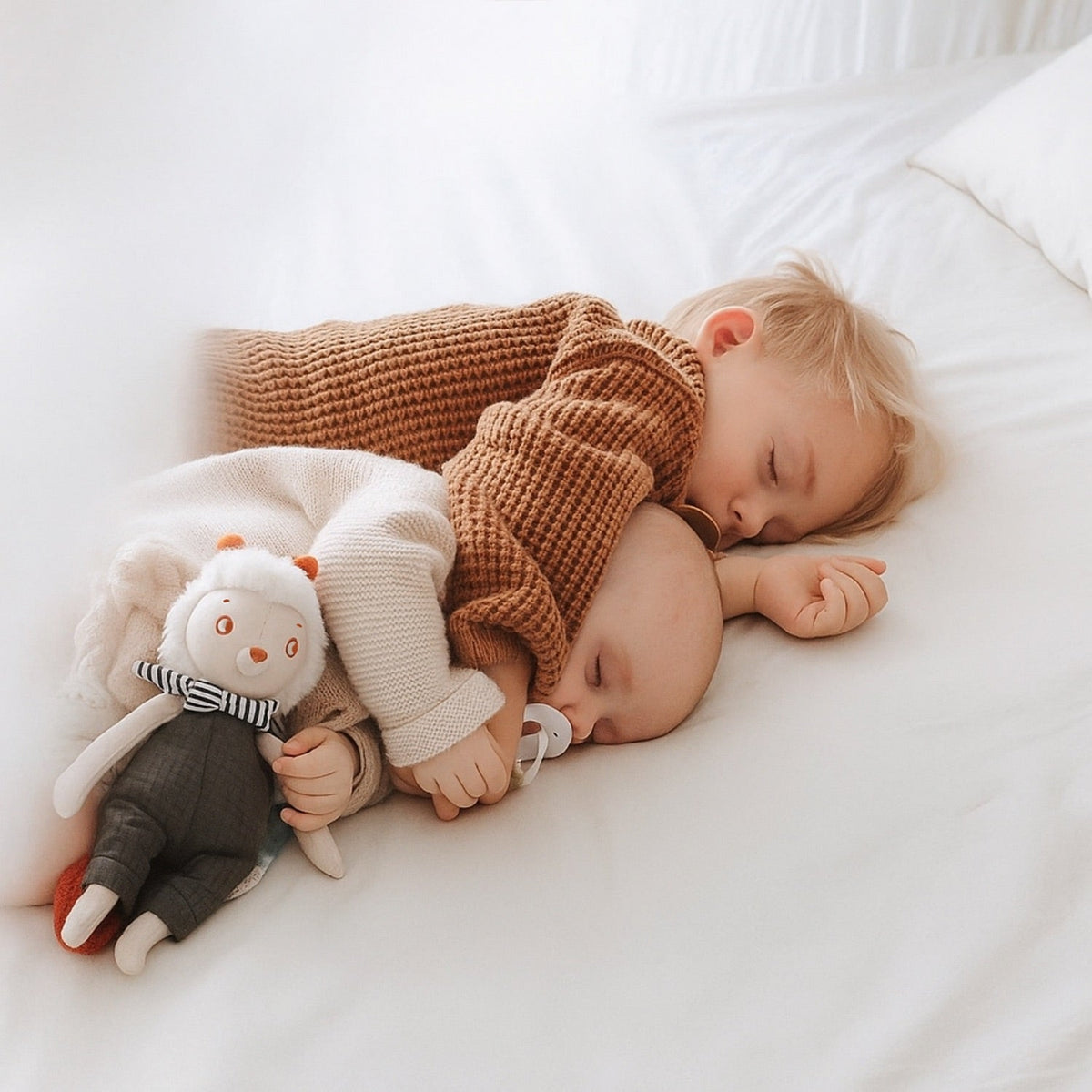


A newborn doesn't need a lot of toys. They need a few well-chosen items that are pleasant to touch, simple to look at, and above all, safe to bring close to their face, hands, and, very soon, their mouth. This is where many purchases go wrong: people buy something "cute" or highly advertised, when in the first few months, what really matters are the materials, construction, and actual age appropriateness.
If you're asking yourself, "What toys are safe for newborns?", the most honest answer is this: toys designed for the very first months are safe if they are made with reliable materials, have no small detachable parts, no dubious finishes, and no excessive stimulation. You don't need the loudest or most technological toy. You need the one that's most suitable.
What toys are safe in the first few months
In the first 0-3 months, play for a newborn almost always coincides with sensory exploration. They look at contrasts, slowly follow movements, listen to delicate sounds, and reflexively grasp what they touch. For this reason, the best toys are often the most essential.
A small, light rattle, a soft doudou, a well-finished sensory quilt, or a textile toy specifically for newborns can work very well. Activity arches with simple, well-spaced elements can also be useful, as long as they are not overloaded with dangling parts or unnecessary decorations.
The point isn't just the age indicated on the package. The point is how that toy is constructed. A baby rattle must be light and easy to grasp. A newborn plush must have solid seams, embroidered details instead of attached accessories, and uniform stuffing. A sensory toy must be designed for close-up use, not to impress adults on the shelf.
The criteria that truly matter
When evaluating a toy for a newborn, the first question shouldn't be "will they like it?" but "was it well-designed for this stage?". Safety comes from a sum of details.
Safe and pleasant materials
Natural or otherwise controlled materials are often the most reassuring choice, but reading "cotton" or "wood" isn't enough to feel completely at ease. What matters is that the fabrics are soft, well-dyed, resistant to washing, and suitable for frequent contact with skin and mouth. What matters is that the wood is smooth, well-sanded, and treated with finishes suitable for infancy.
For newborns, surfaces should be easy to clean and free from strong odors. If a toy has a noticeable chemical smell right out of the package, it's not a good sign. Quality can also be perceived this way.
No small parts, long cords, or fragile elements
Plastic eyes, attached bows, decorative buttons, poorly secured bells: anything that can detach should be avoided. Long laces, ribbons, or cords also require attention, especially if the toy is used in the crib, car seat, or near the face.
Newborns don't use toys as adults imagine. They rub them, squeeze them, suck on them, and receive them in their hands unpredictably. For this reason, even a very beautiful object, if delicate or too decorated, may not be the right choice.
Weight, size, and shape
A toy for newborns must be lightweight. If it's too heavy, it can slip onto the face or be uncomfortable to handle. If it's too large, it becomes difficult to use. If it has sharp edges, rigid borders, or unintuitive shapes, it immediately loses points.
Round, soft, easy-to-grasp shapes are generally the most suitable. In rattles and early grasping toys, ergonomics matter much more than visual effect.
Which types work best
Among the most suitable toys for newborns are soft rattles or lightweight wooden ones, provided they are certified for this age group. They offer a first relationship between movement and sound, without overstimulating.
Doudous and comforters are a classic choice, but they must be selected with care. The best ones are simple, soft, with few details and pleasant fabrics. They can accompany rest or quiet moments, always under supervision in the very first months.
Some newborn plush toys can also be suitable, if they are truly designed for newborns. Not all plush toys are. Suitable ones have a soft structure, embroidered details, small size, and very solid construction.
Moonie, the sweet humming bear, is a professional sleep aid, made from organic cotton and produced in Europe. Thanks to its natural pink noise sounds – more delicate and relaxing than classic white noise – it helps newborns calm down and fall asleep more easily. It reproduces real sounds like a heartbeat, wind, water, and sweet melodies.
Moonie is also a soft night light with 7 colors, equipped with:
- smart crying sensor,
- shake-to-light mode,
- personalized voice recording,
- volume control and timer,
- USB-C rechargeable battery with charge indicator.
Activity gyms and suspended toys can be useful, but only if they don't become an excess of colors, noises, and hanging objects. A newborn doesn't need to be overwhelmed with stimuli. A few well-chosen elements are often more effective.
Fabric tactile books, with simple textures and soft pages, are another interesting option. They are not a "book" in the classical sense, but a first object to explore with hands and eyes.
Which toys are safe for newborns and which to avoid
There are categories that are best postponed, even if they are often given with enthusiasm. Toys with batteries, strong lights, and continuous sounds are rarely the best choice for a newborn. They may seem fun to adults, but they don't add much to the sensory experience of the first few months and often prove to be intrusive.
Also avoid toys with poorly protected hard parts, very furry dolls that shed fibers, objects designed for older children, and all those "developmental" products that promise to be suitable from 0 months upwards but, in fact, are too complex at the beginning.
Another grey area concerns decorative toys. Some items are beautiful for the nursery, but are not designed to be handled by a newborn. In these cases, the line is simple: if it's meant more for decoration than for touching, it's better to consider it decor and not a toy.
The value of a curated selection
When buying for a newborn, the difference between a generic assortment and a curated selection is immediately apparent. Brands with long experience in childhood, carefully chosen materials, and collections designed for the actual age greatly reduce the margin of error.
This doesn't mean that the most expensive toy is always the safest. It does mean, however, that a well-designed product, from a reliable brand, and sold in a specialized context, usually offers more guarantees than an impulsive purchase made solely on aesthetics or price.
This is why it makes sense to lean towards stores that select by age group, type, and construction quality, as is the case on pipipupu.com. Good curation doesn't complicate the choice: it makes it simpler.
For gift-givers: what to really look for
Those buying a gift for a newborn often look for something tender, memorable, and well-made. This is a good intention, but it's worth adding a practical filter. Can that toy be easily washed? Is it soft but not fragile? Does it have embroidered details? Is it declared suitable from birth? Is it simple enough to use immediately?
A well-chosen gift doesn't necessarily have to be "special" in a flashy way. Often the toys that truly last are those that accompany daily routines: a small doudou, an elegant and lightweight rattle, a soft newborn plush toy to keep nearby during quiet moments.
If you're undecided between two items, for a newborn, the more essential one almost always wins. Easier to clean, easier to grasp, easier to integrate into the day.
Safety yes, but also beauty and measure
There's a somewhat outdated idea that a safe toy must necessarily be trivial, poor, or poorly crafted. This is not the case. Today, you can find toys for newborns that combine safety, pleasant materials, and an aesthetic that is also beautiful for adults to see.
This matters more than it seems, because a child's first objects enter the home, routines, photographs, and small daily rituals. A well-made and well-designed toy doesn't just serve to "occupy" the newborn. It carries with it a certain idea of childhood: calmer, more essential, more attentive to quality than to noise.
Ultimately, choosing a safe toy for a newborn means doing something very simple: reducing the superfluous and trusting in what is well-designed. If an object is soft, clean in its forms, suitable from birth, and carefully constructed, it's already off to the right start. And in the first few months, the right way is always worth more than the surprise effect.
0 comments